Diana Dors – Still in my heart after 30 years

Leave a comment

The eternal image of how Diana Dors is remembered....

The eternal image of how Diana Dors is remembered….


On May 4 1984, the first homegrown, British sex symbol – Diana Dors – died. She was just 52, and the cause of death was ovarian cancer. As Dors also was quite well-known in Norway, the news of her passing reached us pretty fast, and a lot of Norwegian fans were shocked to hear she was gone at such a young age. Today, exactly 30 years to the day of her death, I will post this small tribute to this legendary British actress and sometime singer…..

A young Diana in 1952

A young Diana in 1952


Personally, I was too young to have seen Dors at her sex symbol height, but to me she was a very likable actress who showed up in a lot of movies during the 1970s, usually in meaty supporting parts in the endless line of British horror flicks and risqué comedies produced there during that decade.

Later on (when we got a video player in our house!) I saw a lot of her movies from the 40s, 50s and 60s as well, made back when her roles were bigger, and she was always a treat to see. Being the UK’s answer to all the busty, American blondes, Dors was of course regarded in the same light as Marilyn Monroe, Mamie Van Doren, Cleo Moore, Joi Lansing and all the other blonde bombshells. However, Diana Dors always seemed to be much more down to earth, and with a sense of humour about her own sex godess image, sure she was sexy, but always with tounge-in-cheek! And to top it off; when she got good material, she was one hell of an actress too. Her 1957 Movie “Yield To The Night” is often cited as her best work, and if you’ve never seen Diana Dors on film – treat yourself to this one! Great movie, great acting.

Perhaps her finest film, this 1957 production shows just how good she could be!

Perhaps her finest film, this 1957 production shows just how good she could be!


Dors was a celebrity of the highest rank in the UK, and in addition to all her films (ca. 80, made between 1947 and 1984), she was also doing cabarets, dinner Club work, TV series, and she was an ever popular chat show guest due to her natural charm and quick remarks.

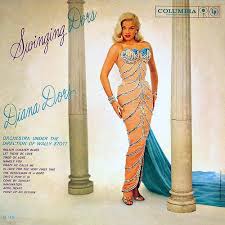
Diana - the singer! Her album "Swingin' Dors" (1960) is a great collection of classic pop songs

Diana – the singer! Her album “Swingin’ Dors” (1960) is a great collection of classic pop songs


As with all celebrities, Diana Dors also was subject to a lot of rumours and gossip about her private life, her husbands, her private adult parties and her sex life. All of this caused such a stir, that it is sometimes hard to see that Dors made a great contribution to the world of film, and that she deserves to be remembered for her film work instead of her private life.

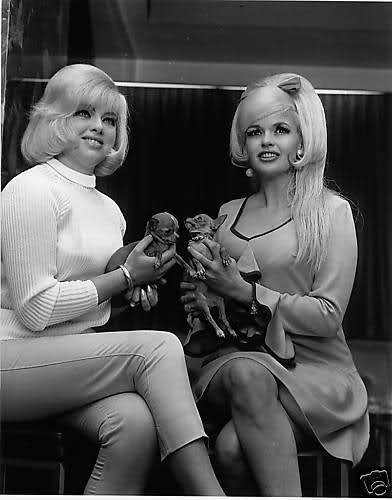
The British Bombshell meets an American one; Diana and Jayne Mansfield in 1967

The British Bombshell meets an American one; Diana and Jayne Mansfield in 1967


Even today, Dors is fondly remembered by a lot of movie goers around the world. Some might think of her as of one the blonde sex symbols of the 1950s, some might think of her as the fine actress that she was.

There is a great website about Diana, where you can see a lot of photos, a complete list of her films and TV work and much more. Check it out:

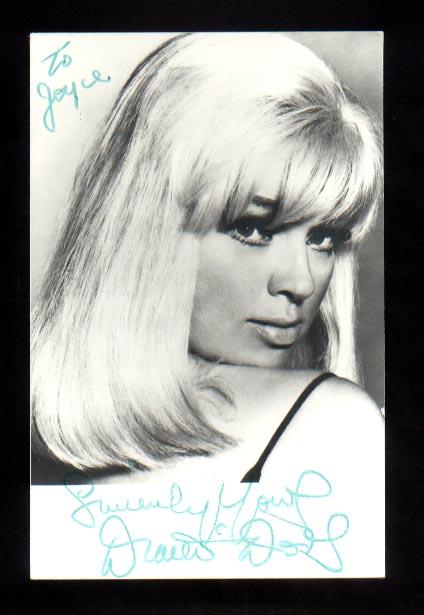
"Here's looking at you..." A beautiful photo of Dors from ca. 1970

“Here’s looking at you…” A beautiful photo of Dors from ca. 1970


Today, the day of the 30th anniversary of her passing, I am sure a lot of Diana’s fans around the globe will think of her, and maybe watch a movie or two in honor of her memory. She did dramas, comedies, thrillers, horror movies and even a western (“Hannie Caulder“, 1970), so there is a lot to choose from. No matter what kind of film you end up with, Dors is always a treat to watch, and she has the kind of magnetic personality that makes it impossible not to notice her when she’s on-screen…. And that’s why we are still watching!

A photo from the early 1980's. Diana still looked great, even shortly before here untimely death

A photo from the early 1980’s. Diana still looked great, even shortly before here untimely death


Odyssey – Still Fresh (and never “used up” or “worn out”)

Leave a comment

Of all the groups that arrived on the soul, disco or pop scene during the last half of the 1970s, none was more exciting than Odyssey! Their hybrid concoction of soul, disco, jazz and pop makes their recordings something very special, a mix that was not heard until they came on the scene (and not since, for that matter!). Odyssey´s music is almost a category of its own. And added to the mix – the sultry, smoky, soulful vocals of their late, great lead singer Lillian Lopez (1935 – 2012).

The trio may be considered as another soul/disco group of their time, but what they did musically expands way beyond that classification. If they can be compared to any other artist of the same period, it is The Manhattan Transfer. That group, like Odyssey, took jazz based vocals and set it to a wide array of different musical styles. They swung jazz like hell, but also did pop tunes and even disco. So, in a way, it is unfair to just relegate Odyssey to the soul and disco bins, their music stretched into a lot of other styles – and should be appreciated as maybe the most commercial fusion ever made in the recording business!


Odyssey ca. 1980. Lead singer Lillian Lopez on the left

Odyssey ca. 1980. Lead singer Lillian Lopez on the left


Although they made just 5 albums during their heyday (1977 – 1982), each and every one of those albums is a masterpiece! Transcending category, they enjoyed greater success in the UK and Europe than in the US – the Americans doesn´t seem to have taken to their mix of styles as well as the Europeans. While their break-through hit “Native New Yorker” was a big hit in the US, they later joined the “exclusive club” of US artists hitting number 1 in the UK without reaching the hot 100 on the US charts; “Use It Up, Wear It Out” was of course the reason for that….

Somehow, all their original albums never made the LP-to-CD revolution in the early 80s, and since their original release none of their albums have been available in their original versions, until now! Thanks to the British reissue label Big Break Records, they now are ready for the world to enjoy them again in all their glory . This post will take a closer look at those fabulous discs, so journey with me through the musical universe of Odyssey…


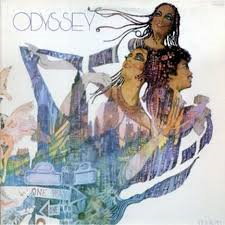
Their first album, titled "Odyssey" came out 1977

Their first album, titled “Odyssey” came out 1977


When “Native New Yorker”  was released in 1977, it quickly took off and giving the group its break-through hit.  With its fabulous arrangement, and lyrics celebrating New York life, it certainly found an audience very quickly. Even today it is the song that the group is best remembered for. The song was covered (in versions true to the original) by both Esther Phillips and Frankie Valli.

Since the song was a disco styled pop tune, you’d expect their debut album, simply called “Odyssey” to be in the same mould…. It was however, a very diversified collection, incorporating some groovy Caribbean rhythms on “Weekend Lover”, “The Woman Behind The Man” and the 7 minute plus opus “Easy Come, Easy Go/Hold De Mota Down”. Lyrically, the album also dealt with stuff that went way beyond the usual pop clichés; “Ever Lovin’ Sam” is an ode to the narrators much older husband, “Golden Hands” deals with a guy struggling to get out of the ghetto and make a better life, and “Thank You God For One More Day” is a great uptempo pop tune with inspirational lyrics. All of it flawlessly performed by Lillian, backed by great background singing and totally wonderful, live musicians. It just may be the best record made in 1977!


The second album, "Hollywood Party Tonight (1978)

The second album, “Hollywood Party Tonight (1978)


Their sophomore album, “Hollywood Party Tonight” came out 1978, and was like it’s predecessor a very mixed affair. The album saw very little chart action, and the one single released, “Lucky Star” didn’t turn into a hit at all. Still this album is very enjoyable, and although maybe the least known of their albums, it really should be rediscovered. They took a big chance by making an album that bucked all the current trends of 1978, and stylistically this album sometimes evokes musical trends from earlier decades, yet all the while sounding very contemporary.

I choose to quote music critic Steven E. Flemming Jr. who wrote the liner notes for the CD reissue – he’s nailed it best when describing the album like this: “Over the course of eight thoughtful tracks, the album tells a timeless coming-of-age saga. The heroine at the center of the fable navigates the ups and downs of love and life against a swinging, Broadway-style suite flush with dramatic peaks and valleys – and the singers, propelled by Lillian Lopez’s first-rate instincts as an interpreter, lend Technicolor vibrancy to this slice of storytelling.”

Fusing 1940s big band style to a disco-ish beat on “Single Again/What Time Does The Balloon Go Up” makes for a great opener. The next song, “Pride” is also great, a mix of rock and disco. “I Dare Ya” has some latin influences, although it is also quite jazzy. “Lucky Star” is a mid-tempo pop ballad with (yet again) lyrics that tell a great story, much like the one about the New York native, but this time set in Las Vegas. They also do the song that must have the longest song title ever in the history of music; “You Wouldn’t Know A Real Live True Love If It Walked Right Up Kissed You On The Cheek And Said Hello Baby”….!!


The 1980 album "Hang Together"

The 1980 album “Hang Together”


Odyssey was back in 1980, with their third album “Hang Together“, the parent album of their greatest UK hit, “Use It Up And Wear It Out”. Opening with the midtempo groove of the title track, the album gets off on a socially conscious  note, as its lyrics deal with the problems in society (and not hanging out at clubs). The lyrics seem just as relevant today, so unfortunately – the changes Lillian so desperate wanted in 1980 still haven’t happened… But the song can also send you straight for the dance floor, despite the downbeat lyrics. After the ballad “Never Really Had It All”, it’s back to the club grooves on another perennial Odyssey favorite, “Don’t Tell Me, Tell Her”. The track is a funky, enjoyable song dealing with yet another look at the eternal love triangle of two girl and one guy. It was redone in 1981 by Phyllis Hyman on her great album “Can’t We Fall In Love Again”. Of the two versions, I hand the prize for best one to Odyssey; Ms Hyman at this point was so hyped up to be the soulful “godess of love” that she overworked a lot of her material, bending notes any which way and hardly singing anything “straight” and trying way too hard to prove her soulfullness….

Next up is one of the few rock tracks Odyssey did, “Down Boy”. With its sharp guitars and rockabilly influenced rhythm, it’s a fun track and it stands out in the Odyssey songbook. I can easily imagine Freddy Mercury & Queen doing this song! After the playful “Follow Me (Follow The Leader)”, the stage is set for the albums magnum opus: “Use It Up And Wear It Out”. It topped the UK charts, while never entering the charts in the US. Just why, is a big mystery – it is one the best Dance/soul tracks ever made, and a true classic example of just how good the mixing of soul, Caribbean influenced rhythms and a disco-y beat can be! If you never heard this song, make sure you do very soon, it’s a classic!

Lillian Lopez was always praised for her great singing, but unlike a lot of other “soul divas” she didn’t indulge much in slow grooving, heart felt ballads that call for a lot of wailing and screaming. She is, however, at her ballad best on “If You’re Looking For A Way Out” – the track that follows “Use It Up And Wear It Out”. A total stunner of a beautiful ballad, Lillian’s voice trembles with emotion, and the result is THE best ballad Odyssey ever recorded. The original album closes on a playful note, with “Rooster Loose In The Barnyard” – a steaming funk track that starts with the line “This is a dirty song, send all your kids to bed“!


Their 1981 album "I Got The Melody"

Their 1981 album “I Got The Melody”


1981’s “I Got The Melody” started off with a jazzy arrangement of the Patti Austin composed title track, but the next track was the true highlight of the album; The “Roots Suite” consists of three tracks blended together, “Ajamora Ayega (Freedom For All)/Going Back To My Roots/Baba Awa”, one tracks seamlessly seguing into the other on this 10-minute suite. “Going Back To My Roots” is another of the classic Odyssey tracks that was a huge hit in Europe at the time (and was redone and clubbed up by Linda Clifford a few years back). It is yet another example of just how exciting the group could sound, and it’s notable also due to the fact that Lillian doesn’t sing lead on it – Bill Mc Eachern does that.

Odyssey’s only ever did two cover versions of other people’s hits, and the first one  appears on this album; they do a reggae influenced take on Maxine Brown’s 60’s classic “Oh No! Not My Baby” – a smart move, as the countless other versions (from Rod Stewart and Dusty Springfield to Cher) were all done as a ballad. This album also contains another memorable song, the gentle and very beautiful “It Will Be Alright”.


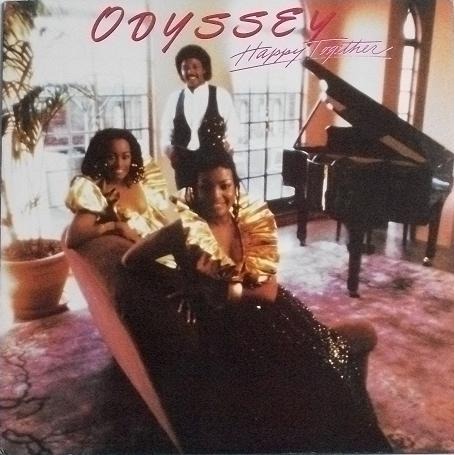
The last in line of the classic Odyssey albums, "Happy Together" (1982)

The last in line of the classic Odyssey albums, “Happy Together” (1982)


The fifth and final classic Odyssey album, “Happy Together” came out in 1982. Starting off with a track written and produced by Chic’s Nile Rodgers and Bernard Edwards called “Together”, it has all their usual trademarks of guitar licks and hand clapping rhythms, but it’s not one of the more vocally demanding songs for Lillian’s voice. “Inside Out” follows, and it’s another truly great song, and one that is also remembered as one of the classic Odyssey songs. The title track is their remake of the 60’s hit sung by The Turtles (and also done in the early 1990’s by Jason Donovan), here given a soulful and funky sheen lasting for more than seven minutes…

The album closes with the minor hit single “Magic Touch” – a title befitting most of Odyssey’s music in general! The first five albums played back to back gives you a musical journey of great music that sounds like nothing else, and personally I am overjoyed by the fact that these classic albums now are available on CD!

After leaving RCA, they recorded one more album, “Joy” in 1985 on a smaller label, and the song “Joy (I Know It) was a very minor hit, but giving Lillian another chance to shine.

In the years since then, Odyssey as a group has seen several changes in personnel and haven’t done a whole lot of recording, although a new incarnation of the group has re-recorded some of their old hits…. Lillian Lopez left the group in the late 1980s, and basically retired from the business altogether. She died of cancer at the age of 77.


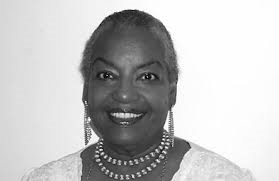
The golden voice of Lillian Lopez was silenced forever in September 2012

The golden voice of Lillian Lopez was silenced forever in September 2012

Odyssey’s musical legacy proves them to be one of the truly great groups of all time, and I hope a lot of you will be re-accquainting yourselves with all this great music. They deserve to be remembered for so much more than just a couple of dance hits from the 70s & 80s. If music can in any way be termed as “luxurious” – the sound of Lillian Lopez and Odyssey is exactly that!


Sheena Easton – The great Scot!

6 Comments

Flashback to late 1980: two young boys of 14 from the suburb of Haugerud, Oslo are about to enter the Grand Hotel in downtown Oslo. They are on an assignment for their school paper, to do an interview with a new singer who’s just released her first single. We are guided into a smaller room, and in there is a beautiful young woman of about 20, obviously tired from travelling and promotion gigs, but none the less cordial and smiling while sipping on a glass of mineral water… The first thing we notice is that her English accent is different from the kind of English we’ve learned in school – but then we remember that she is Scottish. We ask her all the questions we had prepared, and one of them concerns what she will be doing next. Her reply to that is that she is preparing her first album, and that there had been some talk about recording the theme song for a movie…. When we finish, she gives us a hug and wishes us both good luck with our school paper. Oh my God! At age 14,  I’ve just been hugged by Sheena Easton!

On that day, more than 33 years ago, neither she nor I could have known what direction her career would take. Miss Easton probably might not even remember this “interview” (but I certainly do!). She was a newcomer with a bright musical future predicted, and boy did she fulfill those expectations! In a matter of weeks after our meeting, Sheena’s debut album came out and she went from promising newcomer to full-fledged pop star in a very short time. In the last 15 years, Sheena has been out of the spotlight (at least in Europe), so this is a reminder of a spectacular recording career that produced an awesome amount of great music.

Sheena Easton around the time when I first met her..

Sheena Easton around the time when I first met her..

Chronologically, Sheena’s recorded output spans exactly 20 years; her first single came out 1980, and her (so far) last album came out in 2000. In that time span, she made 15 studio albums, had numerous hits, she received a total of seven Grammy Award nominations (winning two of them). She is also the only artist ever to have Top 5 hits on each of  Billboards key charts : “Morning Train” (Pop, Adult Contemporary), her duet with Kenny Rogers, “We’ve Got Tonight” (Country),”Telephone (Long Distance Love Affair)”  (Dance), and “Sugar Walls” (R&B). And she also joined that exclusive bunch of singers who have performed the title song to one of the James Bond movies, Sheena’s contribution being, of course “For Your Eyes Only” (1981). Her international break-through single, “Morning Train (9 To 5)” reached number 1 in the US, and thus making Sheena the fifth British female singer to achieve that feat. She was preceded by Vera Lynn (“Auf Wiederseh’n Sweetheart”, 1952), Petula Clark (“Downtown”, 1965/”My Love”, 1966), Lulu (“To Sir With Love”, 1967) and Kiki Dee (“Don’t Go Breaking My Heart”, 1975 – in a duet with Elton John) Sheena was born on April 27th 1959, in the Scottish town Belshill, where she grew up as the youngest of six children. She was a student at the Royal Scottish Academy of Music and Drama (situated in Glasgow) 1975-79. In 1979 she married, and thus got the surname Easton. She was also chosen to star in the TV show “The Big Time” – having a camera team following here around for a year as she was trying to get herself into the music business….  Her first single, “Modern Girl” was released to coincide with the TV show.

Sheena's 1980 debut single

Sheena’s 1980 debut single

While singles like “Modern Girl” and “One Man Woman” didn’t exactly burn up the charts, the next one did; “Morning Train” was the song that launched Sheena’s career. It was a huge hit all over the world, and even made it to number 1 in the US. Her first album, “Take My Time” followed – and it was a nice mix of lovely ballads and up-tempo pop songs. Sheena then recorded her James Bond theme song, “For Your Eyes Only” – and she was visible in the movie’s opening sequence, singing the song while the credits were rolling.

The very first Sheena Easton album (1981)

The very first Sheena Easton album (1981)

Off to a flying start indeed, Sheena and her producers quickly put out another album, “You Could Have Been With Me” (1981). Containing the same mix of ballads and uptempo songs as her debut, but showing signs of her development into an even better singer (although, what was there to begin with was pretty awesome too!). Hits from the album was “A Little Tenderness”, the lovely title track – featuring a stunning vocal performance, and the great dance track “Just Another Broken Heart”. Along the way, “For Your Eyes Only” was nominated for the Academy Award for best original movie song, and Sheena performed it during the Oscar ceremony. She also won the 1981 Grammy for Best New Artist. Her third album “Madness, Money & Music” gave her more hits in the form of “Are You Man Enough”, “Ice Out In The Rain” and “Machinery”. On this album, she also sang the (now) semi-standard “Wind Beneath My Wings”, that later was a big Bette Midler hit, while also being recorded very well by Gladys Knight, Gary Morris and Freda Payne. Another stand-out performance on this record is “I Wouldn’t Beg For Water” – one of her best songs ever! So, how can one describe the Easton voice…? Sheena has a crystal clear, very pure voice, that is capable of great vocal flexibility. She can reach some very high notes, and when she does – she never screams or yells, instead it seems like she makes her voice swell, adding power. She can also lower her voice down to a throaty, sexy whisper – and she can scale up or down from one to the other in matter of nanoseconds. Talented enough to put her gorgeous vocals to great use on everything from country ballads, big band jazz and electronic disco; Her 15 studio albums form a musical documentation of a one-of-a-kind singer with a great voice that never sounds, even remotely, like anybody else. 1983 was the year when Sheena stepped a little away from the formula of ballads/pop apparent on her first three albums. She duetted with country music superstar Kenny Rogers, and they landed a big country hit with “We’ve Got Tonight”. She also teamed up with Mexico’s Luis Miguel on the duet “Me Gustas Tal Como Eres”, and thereby also making her first appearance on the latin Music Charts! She made another album, “Best Kept Secret” – from which “Telephone (Long Distance Love Affair)” was a major hit. And boosted by her success with Luis, she also recorded a Spanish language album, “Todo Me Recuerdo A Ti” – featuring Spanish versions of her greatest hits and some new songs.

Her 1983 album "Todo Me Recuerdo A Ti", sung entirely in Spanish

Her 1983 album “Todo Me Recuerdo A Ti”, sung entirely in Spanish

Having proved her versatility, 1984 saw Sheena go through a change of image, and opting for a darker, funkier style of music. The first result of this was her new album “A Private Heaven“. No less than three hit singles came off this album; “Strut”, “Swear” and “Sugar Walls”. She received another Grammy nomination for “Strut” (Best female pop/rock vocal performance). “Sugar Walls” (written by Prince) was banned from radio play due to “sexually suggestive” lyrics, but still made it to number 3. This album also features a stunning take on Joan Armatrading’s “Love And Affection”… Nile Rodgers had pulled the best out of Chic, Sister Sledge and Diana Ross, as well as Carly Simon and Debbie Harry – when he was assigned as Sheena’s producer in 1985. Their joint effort, “Do You” is indeed an achievement to be proud of! Although no big hits appeared on the album, it’s still well worth searching out. It contains some of the most outstanding songs she’s recorded. “Do It For Love”, “Don’t Turn Your Back”, “Young Lions”, “Don’t Break My Heart”. She also does an updated version of the Vandellas’ old hit “Jimmy Mack”. Around this time Sheena often performed another 60’s nugget – The Crystals “He’s A Rebel”. Why it wasn’t put on the album, I don’t know – it would have benefited greatly from the Nile Rodgers magic touch as well… Sheena was then headed for some bad Luck; due to problems with the record label, her next album wasn’t very well promoted – and it sort of fell under radar, and had a limited release. Pity, because “No Sound But A Heart” is another great Sheena Easton record, and tracks like “Wanna Give My Love”, “Eternity” and “Still In Love” are all very good.

1987 album "No Sound But A Heart" suffered from bad promotion...

1987 album “No Sound But A Heart” suffered from bad promotion…

That streak of bad Luck was to disappear the next year though – 1987/1988 saw Sheena reach number 2 on the charts on two occasions, she made another great album that was very successful, and she branched out into acting…. She had already done one of his songs on her “A Private Heaven” album, and this year she got to duet With the man himself; Prince! Their joint efforts on “U Got The Look” turned into a big hit, and landed the number 2 spot on the charts. They also got nominated for two Grammy awards for this song. Sheena then had a recurring guest role on TV’s “Miami Vice”, playing Don Johnson’s girlfriend, a singer named Caitlin Davis. She performed “Follow My Rainbow” in one of the episodes, and the song was also included on her 1988 album “The Lover In Me“. The title track of this album also reached number 2, and she had further hit singles with “Days Like This”, “101” and “No Deposit, No Return”. Having by this time permanently settled in the US (she would obtain citizenship in 1992), Sheena was looked upon as an American singer, and also having more success there than in Europe. She performed at the “Big Day” Festival in Glasgow in 1990, revealing that she now spoke with an American accent. When telling the audience it was  good to be “back home” without a trace of Scottish accent, Sheena had bottles thrown at her, was booed off the stage and forced to cut her set short. Obviously angry and hurt, Sheena vowed never to perform in her land of birth again! In the early 1990s, there was a musical fad going on, called “New Jack swing”, that was a combination of R’n’B singing over hip-hop influenced beats, and singers like Janet Jackson, Keith Sweat and Paula Abdul were notable exponents of this style. Sheena got into it as well, on her next album “What Comes Naturally” (1991). The title song gave Sheena another Top 20 hit in the states (her last), and this album also include the outstanding power ballad “To Anyone”. The album itself is actually very good, and Sheena does a great job even on this stylistically strange kind of music. The album stands as one of the very few really good examples of New Jack swing, the other being Tiffany’s “New Inside” cut the same year.

The 1991 album.... Most things sounded "naturally" when performed by Sheena - even New Jack swing!

The 1991 album…. Most things sounded “naturally” when performed by Sheena – even New Jack swing!

Having proved her talent for doing a variety of musical styles, and spreading her fabulous voice on everything from country to Spanish boleros and pounding R’n’B – where could Sheena go vocally? She answered that question by cutting “No Strings” in 1993 – a low-key, jazzy album on which she performed old standards. This collection of music is absolutely stunning, and Sheena obviously enjoys herself singing these songs. Backed by piano, bass, drums and occasional horns, she holds the spotlight all on her own, and proves once and for all that her voice really needs no big backing – it is a beautiful instrument on its own. Her performances on songs like “Body And Soul”, “The Man That Got Away” and “Never Will I Marry” are among her best recordings, and certainly the best versions of these songs ever recorded!

Her 1993 jazz album is a stand out! Adapting to a new style, Sheena sounds great!

Her 1993 jazz album is a stand out! Adapting to a new style, Sheena sounds great!

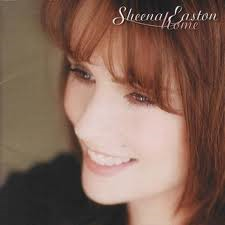
During the last 20 years, Miss Easton has made four new albums (1995-2000), adopted two children (Jake and Skylar), done Casino gigs and corporate shows – and thus combining motherhood and performing. She also starred on Broadway, playing Aldonza in “Man of La Mancha” opposite Raul Julia, and then went on to play Rizzo in “Grease“. She lives in Henderson, outside Las Vegas with her children. As for the last four albums – “My Cherie” was made 1995, and is a step back to Sheena the pop singer. The best songs on it are “Till Death Do Us Part”, “All I Ask Of You” (not the “Phantom of the Opera”-song), and then there’s “You’ve Learned To Live Without Me” – maybe the most gripping break-up song ever made, and further embellished by an absolutely gut wrenching performance by Sheena. Too bad so few people have heard it! “Freedom” appeared in 1997, with a great opening song – “When You Speak My Name”, hit single potential if ever there was! She also does a very good version of Dorothy Moore’s 1975 hit “Misty Blue” and updates her old hit “Modern Girl” with a slightly techno-inspired arrangement. In 1999 she went all acoustic on her album “Home“, sounding very relaxed and confident on everything from Paul Simon’s “St. Judy’s Comet” and Graham Nash’ “Our House” to the beautiful “Not While I’m Around” by Stephen Sondheim. The album was only released for the Japanese market, and that makes it very little known around the rest of the world. It is a wonderful record though, and highly recommended!

"Home" (1999) shows a natural looking Sheena; the perfect look for this acoustic, low key album

“Home” (1999) shows a natural looking Sheena; the perfect look for this acoustic, low key album

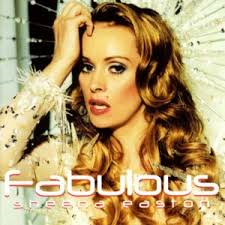
The last collection of music created by Sheena, is 2000’s “Fabulous“. On this, she gets into the mood of disco diva, to such a degree that it makes me think what she could have done had she been old enough to be one in the late 1970s! This is a highly pulsating, pounding record almost from start to finish, and she does a lot of covers of great dance hits from the past: Thelma Houston’s “Don’t Leave Me This Way”, The Emotions’ “Best Of My Love”, The Three Degrees’ “Giving Up, Giving In”, Donna Summer’s “Love Is In Control” are all updated (while staying true to the originals) and are perfect for dancing. She also does a great take on Patti LaBelle/Michael Mc Donald’s no. 1 duet, “On My Own”. Two New songs are on here also: “Get Here To Me” and “You Never Gave Me The Chance”. Since then, Sheena has made no new albums, but there have been several re-issues of her original albums, as well as a flood of “best of” collections….

Her last album is indeed "Fabulous"! A great party record that will keep you dancing....

Her last album is indeed “Fabulous”! A great party record that will keep you dancing….

As far as I know, Sheena has entered the recording studio just once since then, to contribute vocals to “If You’re Happy”, a cover for a Japanese disc called “Cover Morning Musume-Hello Project. She also began work as  host on the TV show Vegas Live, a talk show. In 2004, Sheena was honored by being inducted into the “Casino Legends Hall of Fame” by the Tropicana Casino. Sheena has been rumoured to have made wise investments in real estate, and made the “Rich People” list in a magazine; Sheena has denied this….. What cannot be denied is that Sheena Easton is one fabulous singer, whose 15 studio albums all contain very good music, performed by a one-of-a-kind voice! Played back to back, her albums give a great survey of a talented singer, who can easily tackle any kind of musical challenge. She has occasionally been labeled “Queen of the 80s”, and she sure is a worthy candidate for that – but her 90’s output isn’t inferior either! Sheena is a singer whose career I have followed closely through the years, and I love her songs just a much today as I did back then. Added to it, of course, is the memory of having met her at the very beginning of her long and prosperous career. If ever I meet her again, I will give her that hug back – both cheeks this time around!

Then and now.... These two photos were taken 35 years apart (and show that Sheena has changed very little through the years....)

Then and now…. These two photos were taken 35 years apart (and show that Sheena has changed very little through the years….)

Vikki Carr – One Hell of a Singer!

Leave a comment

Almost a year ago, I did announce a closer look at the great Miss Vikki Carr and her many albums, thereby dipping into the musical legacy of a great singer who is maybe one of the most versatile artists around. To categorize Vikki is close to impossible, but we can roughly divide her career into three different phases: For most of the 60’s she was a pop singer of the traditional kind, for the first part of the 70’s she was a combination of country singer and modern pop singer. And then finally from the mid 1970s and up until today, she claimed her position as the all-round Queen of latin pop. So the 40+ albums she has released since the first one came out in 1963 stands as a unparalelled documentation of how one of the greatest voices in the music business took on different shadings through the years, adapting to current trends, shaping her voice to fit any kind of material – and losing none of her spark and personality through it all.

V is for Vikki! A recent photo from an Award show

V is for Vikki! A recent photo from an Award show

Born in El Paso, Texas in 1941, Vikki was given the fabulous birth name Florencia Bisenta de Casillas Martinez Cardona. She grew up with her 6 brothers and sisters in Southern California. At the age of 20 she was signed to Liberty Records, making her debut single in 1962. Called “He’s A Rebel” – it was a small hit in Australia. In the US Darlene Love recorded it, and as released under The Crystals name, the song soared to number 1 on the charts – and Vikki’s version went nowhere…! Pity, because the two versions are quite similar, and equally well performed. Oh, well – Vikki quickly made a version for the Spanish-speaking market (“Es Rebelde”), and then started preparing her first album, “Color Her Great” (1963).

Miss Carr around the time of her record debut

Miss Carr around the time of her record debut

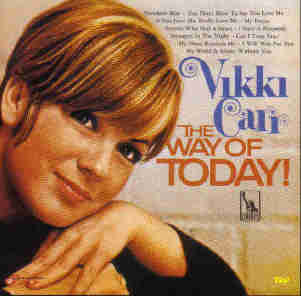
While her first single suggested a pop singer very much steeped in the then-current trends, her first album showed that Vikki chose another direction; she picked most of the material from the classic American songbooks and traditional pop. But by doing that, she carved out her own niche – here was a young, fresh talent doing material from way back, thus combining her youthful appeal with something the older generation also could relate to. Also evident from the opening track was the fact that vocally, Vikki’s voice was far better suited to a little more demanding stuff than what most of the early 60s girl-group pop floss could offer. She opens the album with a zippy version of the old chestnut “Bye Bye Blackbird”, adding to it a professional touch and style that makes it seem like she had spent 20 years in the business already! The next year  she put out two albums, much in the same style as her debut, called “Discovery” and “Discovery II“. The opening track of the first one, is the very first song I heard Vikki sing, and that one that turned me into an instant fan! From the musical Oklahoma, “The Surrey With The Fringe On Top” had been performed for years – but never like this! Vikki starts out sweetly and gently, obviously having a great time acting out the farm girl. Then for the third verse she suddenly adds power, making you jump to attention – then the does the ending in an intimate whisper. It is a great example on “how to do it”; if you choose to sing the standards, you need to add something new and fresh to make your version stand out. That is one thing Vikki Carr did right from the start, and so she made even the most time-worn old songs sound as they were written and tailor-made just for her! She stuck to the same musical formula on her next album, “Anatomy Of Love” (1965), but (as the title might suggest) did a lot more current stuff on “The Way Of Today” (1966) – i.e. doing covers of recent hits like “You Don’t Have To Say You Love Me” and “Anyone Who Had A Heart”, “I Will Wait For You” and “Strangers In The Night”.

This 1966 album marks the transition from traditional to current pop singer for Vikki

This 1966 album marks the transition from traditional to current pop singer for Vikki

If there is one song that will forever and always be connected to Vikki Carr, it’ “It Must Be Him”. It is still her greatest hit, and a song that gave her no less than three Grammy nominations. The single soared almost to the top of the charts, and the album “It Must Be Him” (1967) was a huge hit as well. In addition to its classic title track, this album is also the home of some incredibly good songs like “A Bit Of Love”, “Never My Love” and the completely stunning “Tunesmith” (recorded, equally well, the same year by Johnny Rivers). Riding high on the crest of this hit record, Vikki made three more albums during the late 1960s, the last one being the live “For Once In My Life” – showing that she also had a great connection with her audience! Enter the 1970s – and Vikki changed directions once again – this time to country & western. Both her first two albums of the decade had a very strong Nashville feel to them, and (not surprisingly) proved that she was very good doing this kind of music also. First off came “Nashville By Carr” (1970), followed by “The Ways To Love A Man” (1971).

The 1970/1971 country albums on a 2 for 1 CD

The 1970/1971 country albums on a 2 for 1 CD

Nashville By Carr” is maybe a bit more “country” than its successor. Vikki does a variety of early 70s country songs here, the stand-outs are “Singing My Song”, “The Tip Of My Fingers” and “Sunday Mornin’ Comin’ Down” – very convincingly performed from the female point of view also! “The Ways To Love A Man” is a little more subdued as Vikki goes in for a very relaxed and ballad heavy style on most tracks, along the way making even Bobby Goldsboro’s saccharine “Honey” sound good! The early 70s was a very productive period for Vikki, before 1973 was through – she had made four more albums. The next two are good examples of the kind of luxurious pop music made back then; “Love Story” and “Superstar” (both 1972). Both albums finds the wondrous Vikki backed by sumptuous orchestrations and strings – making them some of the best “adult pop” albums recorded. On the first one, she does great songs like Gordon Lightfoot’s “If You Could Read My Mind”, “If I Were Your Woman” (a then-recent hit for Gladys Knight & The Pips, later done by Bonnie Bramlett, Stephanie Mills and others), a stunning take on Diana Ross’ “Ain’t No Mountain High Enough” and “For All We Know” (a song also done by The Carpenters, Shirley Bassey and Norma Lewis). “Superstar” contains the great title track (written by Bonnie Bramlett and recorded by her twice). It was a hit also for The Carpenters as well as Bette Midler the same year. Other highlights include “I Can’t Give Back The Love I Feel For You”, “The Night They Drove Old Dixie Down” and “Loving Him Was Easier”. This album is also proof of Vikki’s great skills as a singer and interpreter; she waxes soulful on “Spanish Harlem”, plaintively heartfelt on “Crazy Love” and sensuously filled with longing on the title song….

Vikki in the early 1970s

Vikki in the early 1970s

Then it was time to change musical directions once again, and her next album was done all in Spanish; “Vikki En Espanol” (1972). Though she had done some Spanish material earlier, this album is the first time she comes off as a true latin styled singer. The Carr voice is very much the same, but she adds another flavour to it, making all the songs sound like the “real thing” and not like any American singer, just singing in another language. The best example is “Se Acabo” – a fiery chestnut that was also recorded with various  degrees of “latin fuego” by Lola Flores (ay!), La Lupe (explosive!) and even Eartha Kitt (smouldering!). Putting all her Mexican heritage into the music on this album, it is a true achievement and is the first step Vikki took into establishing herself as a major star in the Spanish-speaking music market!

"Vikki En Espanol" - her first step towards her superstar status in the Spanish music market (1973)

“Vikki En Espanol” – her first step towards her superstar status in the Spanish music market (1973)

During 1973 and 1974, Vikki put out the last two of her “American pop” albums; “Ms. America” (1973) and “One Hell Of A Woman” (1974). Both of them finds Vikki squarely placed within the middle-of-the-road, adult contemporary bracket, and she comes off a little like a female John Denver or James Taylor. Both albums are very pleasant listening, filled with great songs – but I also feel that she has fazed out some her of vocal trademarks on these albums – some of the old spark isn’t really there, and on the first listen, it could be anybody singing these songs… You don’t recognize anything very Vikki here. But this doesn’t mean the albums should be avoided, by all means – this is very good stuff indeed!

The 1973/74 albums "Ms. America" and "One Hell Of  A Woman" as another "2 for 1" CD

The 1973/74 albums “Ms. America” and “One Hell Of A Woman” as another “2 for 1” CD

From the 1975 album “Hoy” and onwards, Vikki made almost exclusively Spanish language records, and thus starting another direction of her career. Since then she has churned out one great latin album after another, a complete list can be found on her great website www.vikkicarr.com. In doing so, there was a downside to it as well; By American and international listeners, she is today considered a “60s singer”, someone who “used to make records” and thought of as someone who appears on the oldies circuit, doing her hits from way back when…. It is very far from the truth of course – but an indirect result of limiting herself to the Spanish-speaking market. But her triumphs as a singer has been much appreciated by her new audience: she received gold and platinum records for her hits  “Total”, “Disculpame”, and “Mala Suerte”. Her 1985 mariachi album “Simplemente Mujer” earned her a Grammy Award, her 1992 album “Cosas Del Amor” did the same. Vikki has also received a lot of other distinctions, awards, keys to different cities, an honorary award from the Vietnam veterans, and she has sung for no less than five different American presidents! When looking for Vikki Carr albums, you will find that any and all of her latin albums are widely available, but that a lot of the albums she made 1963-75 might be hard to find – and if you do, they are quite expensive. EMI put together a 3 CD set in 2007, containing 80 songs – taken from her 60’s albums as well as some foreign language versions and some single sides – called “The Ultimate Collection“. This is highly recommended as it gives a great musical portrait of one of the best singers who came on the scene during the 1960’s.

The wonderful Vikki Box Set - treat yourself to this one!

The wonderful Vikki Box Set – treat yourself to this one!

One of her albums may be called “One Hell Of  A Woman“, but a more fitting title might be “one hell of a singer“. In a career that has lasted more than 50 years, Vikki Carr has just about done it all, she has done it incredibly well, she has made a career in two different musical universes – and is just as much respected as a “latin” singer as she is an “American” one. The quality of her recorded output (in any language) is totally awesome. She belongs with the best of the female singers of the 1960s, in the same class as Barbra Streisand, Connie Francis and Liza Minnelli. But then again, the second phase of her career might place her as the female counterpoint to Julio Iglesias as well…. No matter what language or style – Vikki Carr is one great singer – always! Punto y final!

Leonid Larionov – Norges nye stjerne-bass

Leave a comment

Det er med stor glede jeg registrerer at opera som kunstform er på en oppadstigende popularitetskurve i Norge. Vi har et flott operahus i Oslo, det skjer mye på operafronten rundt om i landet ellers – og det ser heldigvis ut til at den gamle myten om at opera kun er forbeholdt noen få, at opera er vanskelig å begripe, det er mye “skrik og hyl” med hjelmprydede divaer som dør i timesvis osv. nå kan legges død. Det norske folk har våknet, og innsett at det finnes helt andre sider ved opera, og at disse heldigvis nå bli oppdaget.

Etter at Oslos nye operahus åpnet i 2008, så har bygningen i seg selv tiltrukket seg mange nysgjerrige besøkende, og heldigvis har ganske mange av dem også fått med seg en eller annen forestilling når de først stakk innom. Det var også et sjakktrekk å ansette Paul Curran som operasjef – han tilførte operaen som kunstform en hel del nye impulser, kreative ideer og sørget også for at vår norske operascene tiltrakk seg nye talenter fra inn- og utland i de årene han virket der.

Derfor har vi nå et sterkt lag av nye og unge operastjerner på vei oppover. Noen navn vi bør holde øye med er: Maria Bordas, Gunda-Marie Bruce, Patrick Egersborg, Julia Gusek, Ingunn Kilen, Magnus Dorholt Kjeldal, Håkon Kornstad og Leonid Larionov. Ikke minst skal vi rette en stor takk til Eli Kristin Hanssveen som med sin deltagelse i “Stjernekamp” høsten 2013 også var med på å folkeliggjøre operasangere og som et resultat av sin glimrende innsats på TV, deretter personlig var en av grunnene til at samtlige forestillinger av “Orfeus & Evridyke” var fullstendig utsolgt! Som et bevis på at dette blir satt stor pris på, ble Eli Kristin kåret til “Årets Sanger” av Operaklubben Arie i februar 2014!

Jeg følger alle disse nye talentene våre med største interesse, og konstaterer med glede at alle sammen gjør en glimrende innsats rundt om der de opptrer, og at Den Norske Opera har et svært godt rekrutteringsgrunnlag til fremtidige rollebesetninger! I min ganske uformelle serie “Stian møter nye opera-talenter“, så er allerede Gunda-Marie Bruce godt belyst (du kan lese det intervjuet her: https://stianeriksen.com/2013/08/02/gunda-marie-bruce-uten-passion-blir-det-kjedelig/ ) og denne gangen er det Leonid Larionov som er i fokus…..
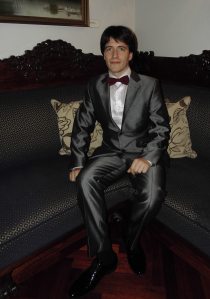
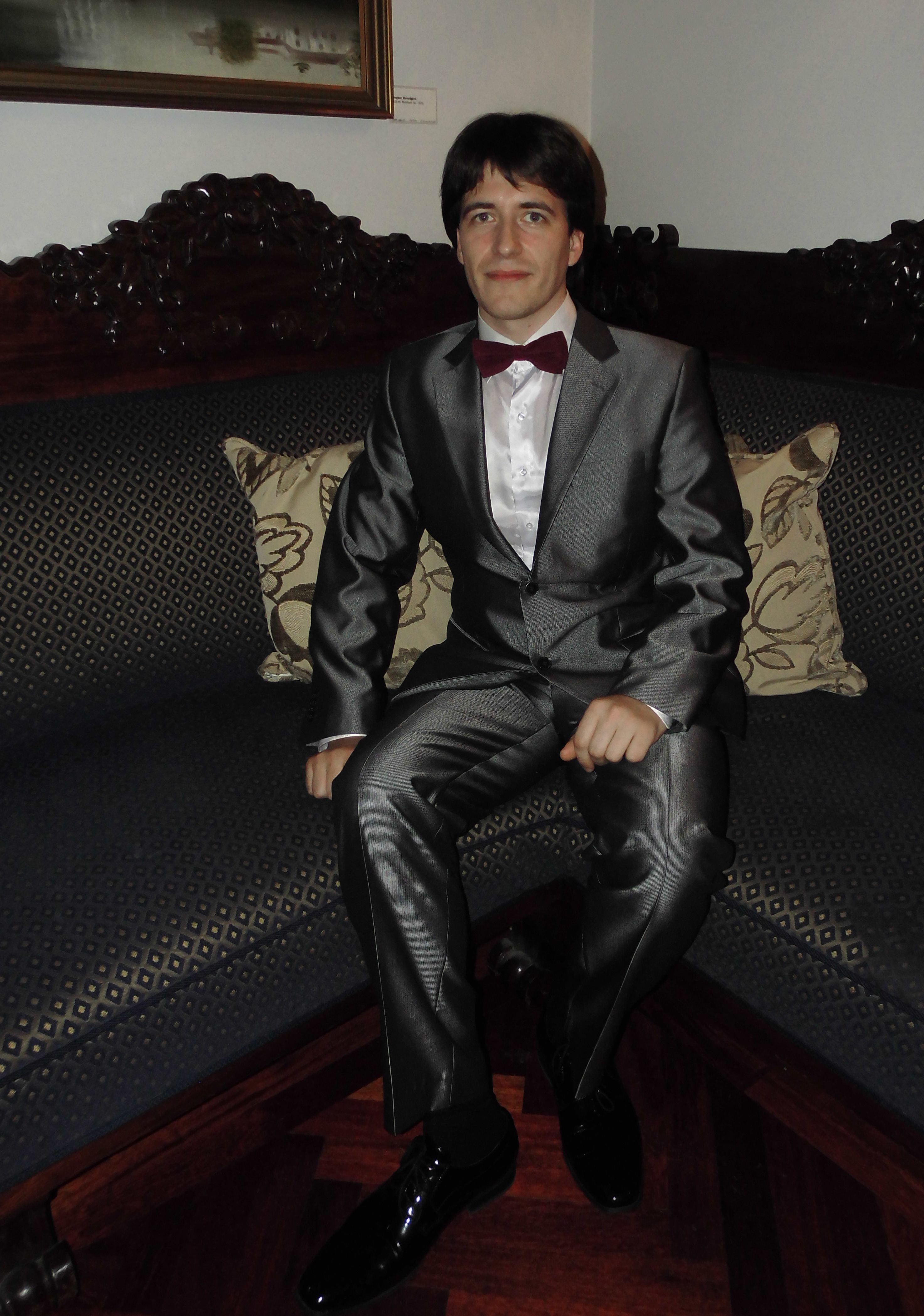
Leonid fotografert i forbindelse med en konsert

Leonid fotografert i forbindelse med en konsert

Leonid Larionov – bakgrunn og fakta: Født i april 1985 i Kandalaksha i Murmansk-regionen i Russland. Fra tidlig alder var hovedinteressene musikk og sport. Leonid var frem til han fylte 21 aktiv innen bobsleigh-varianten “Naturban”, men det var alikevel musikk i ulike former som opptok det meste av tiden:

16 år gammel gikk han ut fra musikkskolen i Kandalaksha med eksamen i pianospill. Samtidig spilte han althorn, trombone og tuba i byens messingblåserorkester. I en alder av 21 ble han uteksaminert fra Rautio Music College, med trompet som hovedfag. Frem til han var 22 studerte han deretter solosang og opera ved konservatoriet i Petrozavodsk. I 2007 startet Leonid det som også i dag er en stor hobby – instrumentbygging.

I tillegg til å være en fremragende bass-sanger, så spiller han også på en lang rekke instrumenter han selv har bygget, bl.a. fløyter, sekkepiper av ulik design, didgeridoo, zhaleyka, harpe, kalimba, munnharpe og til og med sag! En del av disse instrumentene ble anvendt i den tiden han var medlem i folkemusikkgruppen Bahus (det finnes flere klipp med dem på YouTube). Etter å ha jobbet som lærer innen pianospill, blåseinstrumenter og sang i Russland og Finland, kom Leonid til Norge i begynnelsen av dette tiåret og startet studier ved Barratt Dues Musikkinstitutt, der han i dag holder på med Master-studier.
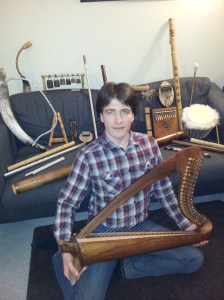
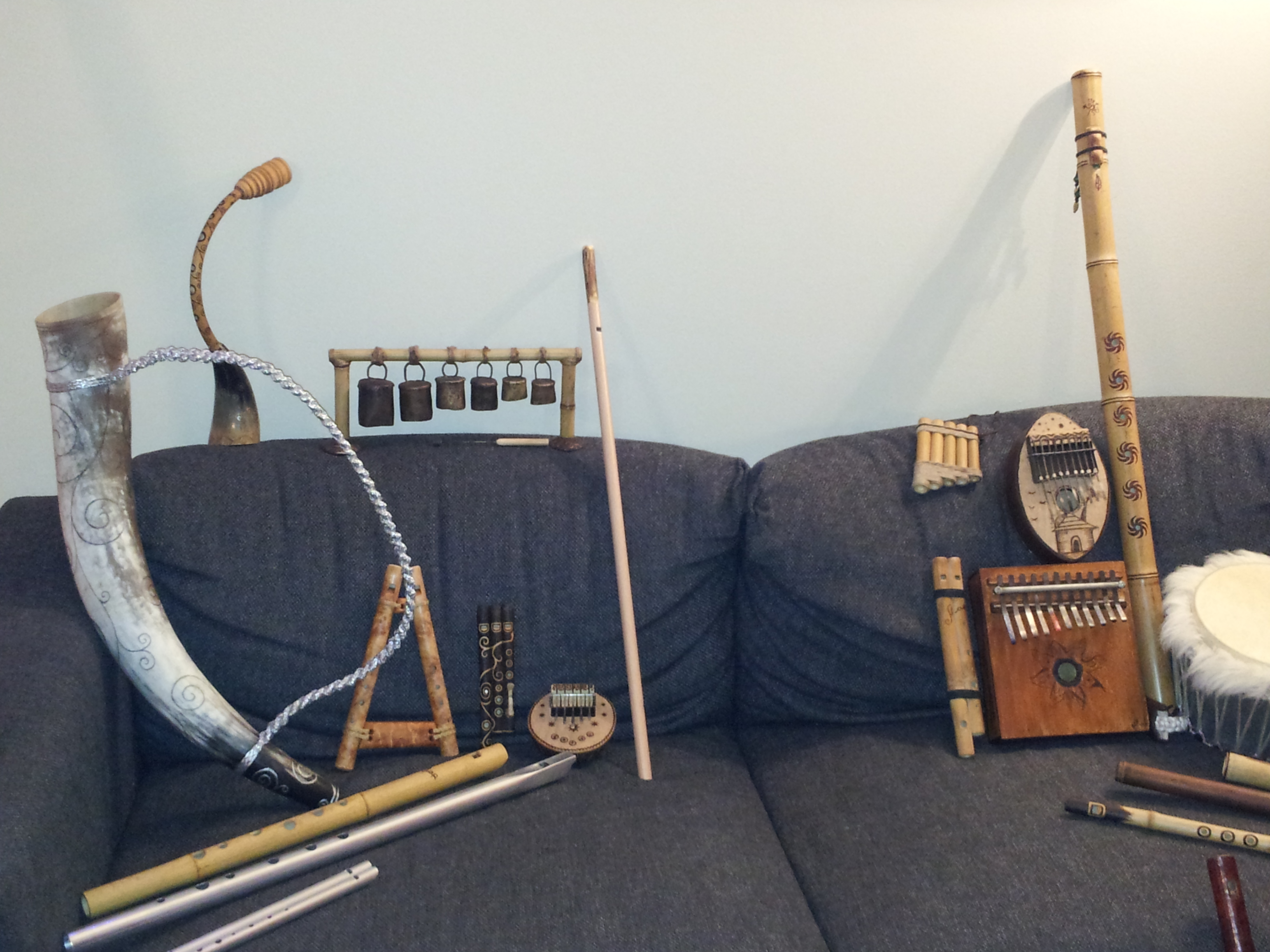
Leonid med en del av instrumentene han selv har bygget!

Leonid med en del av instrumentene han selv har bygget!

Tradisjonelt har det vært sopranene og tenorene som oppnår mest berømmelse innen opera. Mezzosopraner, barytoner og basser kommer liksom litt i bakgrunnen…. Urettferdig, disse er minst like viktige for at en opera skal bli komplett! Etter å ha hørt Leonid live en rekke ganger, har jeg på følelsen at dette kan endres. Leonid har med sin fantastiske og fleksible lyriske bass bevist gang på gang at en bass som solo-sanger gir publikum en helt nydelig musikalsk opplevelse, og at Leonid i samspill med andre er like glimrende som duettpartner og ensemble-spiller som han er solo. Hans rolle som Dulcamara i “L’Elisir d’amore” overbeviste meg om det!

En iskald januardag møttes jeg og Leonid Larionov til et uformelt intervju – et veldig hyggelig møte med en mann som lever og ånder for musikk og sang!

Hvordan skal du profilere deg selv som operasanger, som bass? Er ikke det mye vanskeligere enn f.eks, tenorene som får alle de store “helterollene”? Hva er drømmerollen for en bass?

– Boris Goudonov! Boris er drømmerollen! Men det finnes mange flotte bass-roller hos Verdi også. Egentlig er det mange hovedroller for en bass, kanskje særlig innen russisk opera. Felipe, kongen i “Don Carlo” er et godt eksempel på en flott bassrolle, Gounods “Mephisto” er en annen…. Leporello, tjeneren i “Don Giovanni” også.

Jeg har hørt deg synge kardinal Brogny’s arie fra “La Juive”, blant annet på konserten forrige uke. En opera som kanskje ikke er så kjent her i landet, men som du tydeligvis har et forhold til?

– Kardinalen er ikke “min” rolle, den er for dyp for meg. Arien går helt greit, men hele partiet til kardinalen ligger for dypt for meg! Jeg er lyrisk bass, og kan synge alt fra bass til bassbaryton, men ikke mørk bass. Vokalt ligger jeg mellom bass og bassbaryton.

Det høres ut for meg som du da har muligheten til å være fleksibel i forhold til hva slags reportoar du velger?

– Fleksibilitet, absolutt! Dulcamara derimot er i den helt andre enden, den ligger høyt og der må jeg forholde meg til topptonene hele veien.

Som nyutdannet, og på starten av karrieren så må du kanskje ta noen valg i forhold til hva du fysisk kan synge, og hva som er behagelig å synge…? Det er vel en risiko å gape over for mye, og dermed utsette stemmen for unødige belastninger?

– Ja! Foreløpig kan jeg selv bestemme hvilke romanser og arier jeg synger på solokonserter. Når det gjelder operaroller, er det andre som bestemmer – der blir jeg invitert til å synge roller som er bestemt på forhånd.

Didrik Solli-Tangen og Leonid på konsert

Didrik Solli-Tangen og Leonid på konsert

Som “ny” så må du vel ta de tilbudene som kommer. Dette handler jo også om å skape seg et navn innen opera, folk må vite hvem du er, du må nå ut til publikum på ulike måter….?

– Jeg ser på det som verdifull og nyttig erfaring! All erfaring er bra, og jeg anser at enhver invitasjon til å gjøre noe innen opera gir meg sceneerfaring – det kommer godt med! Foreløpig går det greit for meg å synge det meste av det som byr seg, jeg hverken kan eller har råd til å være kresen på dette tidspunktet (han ler). Etter hvert som jeg får muligheten til å selv velge reportoar, så blir det helt klart mer etter min egen smak. Jeg har veldig lyst å synge noen “gærninger” – Boris Goudonov er jo f.eks, ganske gal! Også noen mere festlige karakterer som Dulcamara og Leporello. Men jeg liker godt tragiske rollefigurer også – de gir spennende utfordringer. En operasanger er en syngende skuespiller, og det er viktig å fremstille figuren både vokalt og karaktermessig! Opera er dramatisk teater.

Som innfødt russer har du en unik mulighet til å synge russisk materiale. Jeg har hørt deg synge Mussorgsky’s “Songs and Dances of Death” og det finnes mye fantastisk flott russisk opera. Men disse er ikke så kjent som verker av Verdi, Puccini osv. Vi oversvømmes av italiensk, fransk og tysk opera – men den russiske kommer litt i bakgrunnen. Du må jo ha en stor fordel når du snakker språket og kanskje også har kjennskap til bakgrunnen for en del av de russiske operarollene. Hvordan skal vi få russisk opera mere frem i lyset?

– Helt klart! Hvis jeg blir kjent, så skal jeg prøve å gjøre det! Det er masse flott russisk musikk som jeg håper jeg kan bidra til å gjøre mere kjent! Jeg skulle ønske at russisk opera blir mer spilt rundt i verden. Problemet er at for få sangere kan synge på russisk. Det er et vanskelig og litt umusikalsk språk å øve inn for noen. Stort sett er det “Eugen Onegin”, “Fyrst Igor” og “Spar Dame” som mer eller mindre regelmessig blir satt opp rundt i verden. Men det er så mye mer å velge blant!

Jeg personlig hadde mer enn gjerne sett deg på scenen på Den Norske Opera i en stor og krevende bassrolle i en russisk opera!

– Ja, takk – jeg også! Operaen må bare ta kontakt og invitere meg! Jeg kan sminkes og kles om til enhver rolle de vil ha meg til å gjøre der! Dessverre er det vanskelig for russiske operasangere å få jobber i Europa. Jeg tror vi mangler kontaktnett – vi blir kun invitert som gjester…. Selv russiske storheter som Anna Netrebko og Dmitri Hvorostovsky har bygget opp det meste av sin karriere i USA, foruten gjesteroller rundt omkring i Europa.

En av grunnene til at jeg har bedt om å få intervjue deg, er fordi jeg mener bestemt at vi må skape litt publisitet rundt deg og det du gjør! Du har en nydelig stemme, og før du er et etablert navn så må det en god del jobbing til før alle vet hvem du er og de store, saftige rollene blir tildelt deg.

– Tusen takk, jeg setter veldig pris på det du og Maud Hurum gjør for meg, ved å sørge for at folk får høre om meg! Det trengs, jeg studerer, tar de oppdragene jeg kan der de tilbys, men jeg skal også betale husleie, telefon og ha mat i kjøleskapet. Jeg burde skaffe meg en agent, tror jeg… En som kan markedsføre meg i alle de rette fora. Som ukjent sanger fra et annet land, så er det nesten umulig å komme på radaren hos de man kunne trenge å komme i forbindelse med!

Hva slags ulike oppdrag tar du egentlig? Kan du bestilles til å synge i begravelser, bryllup, jubileer og alle slags mer eller mindre lokale arrangementer?

– Brylluper og begravelser har det blitt lite av. Jølstad Begravelsesbyrå har ikke mitt navn på sine lister foreløpig… Jeg spurte dem om å komme inn der, men fikk beskjed om at de ikke hadde plass til flere sangere nå. Men bursdager og jubileer har det blitt litt av. Et sted sang jeg helt acappella for jubilanten – kun meg, uten musikere. Litt avhengig av hva slags arrangement det er, men mye kan gjøres enkelt – med en pianist. Skal det være med flere musikere, så må en straks øve mer, det er flere som skal transporteres etc. Men enkelt kan være fint det også! Jeg trenger jo ikke mikrofon engang!!

Ellers har det blitt noen operakonserter, både i Norge, Finland og Tsjekkia. Dessuten har jeg gjort konserter i regi av Gjøril Songvolls prosjekt “Opera til Folket”, bl.a.  på Christiania Bar, Underwater Pub og Pigalle. Jeg har også sunget for Operaklubben Arie, både på medlemsmøter og arrangementer i Thon Hotel Opera. I april skal jeg være med på Fagerborg-festivalen og synge i Universitetets aula – det gleder jeg meg til!

Medfører dette at du må synge noe annet enn opera? Og i så fall – er det OK for en operasanger å synge noe annet enn opera?

– Opera er organisk, og en operasanger kan synge f.eks folkemusikk. Skal du synge pop og rock så blir det noe helt annet, og selv om det er fysisk mulig for en operasanger å synge andre ting, tror jeg det kan slite unødig på stemmen. For meg vil det være veldig unaturlig å synge rock, det ligger ikke for meg.

Hjemme hos Leonid er det ulike instrumenter så langt øyet kan se. Her finnes alt fra noen ganske små perskusjonsbokser til en lang didgeridoo og en ganske stor harpe. Felles for alle instrumentene er at Leonid selv har bygget dem. Jeg skifter tema, og ber ham si litt om hva alle disse instrumentene er…. Det er så jeg lurer på om Leonid har flere timer i døgnet enn oss andre. I tillegg til å undervise elever, studere selv og å synge der mulighetene byr seg – så finnes det minst 40 ulike instrumenter her av ulik størrelse. Noen av dem er så detaljrike, at det er lett å se at dette er noe som tar mye tid.

Jeg peker på en lang uthulet sak, og lurer på hva i all verden er dette for noe?

– Det er et horn fra en bøffel, den er en meter lang. Den er hulet ut, polert og lyder som et vanlig horn. Et instrument som passer godt til folkemusikk.

Han demonstrerer hvordan den lyder, og i rask rekkefølge griper han tak i en indianerfløyte og en utgave av det australske urfolk-instrumentet didgeridoo – og hele huset vibrerer av lyd. En annen, forholdsvis liten fløyte, laget av bambus, lyder som en klarinett. To afrikanske kalimbaer finnes også her, og Leonid spiller rask en melodi på begge to. Kombinert med et par trommer og en “shaker” så er plutselig den russiske bassen forvandlet til et hel-afrikansk enmanns-orkester, og rytmene kommer fra et helt annet kontinent enn Murmansk! Han tar frem en annen fløyte, og denne bringer frem en lyd som jeg tenker på som veldig irsk…. Ekte norsk seljefløyte er det neste, og dermed er det klart for meg hvem som kan være Egil Storbekkens arvtager også!
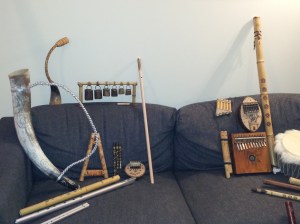
Et utvalg av instrumenter bygget av Leonid selv...

Et utvalg av instrumenter bygget av Leonid selv…

To andre fløyter er modellert etter 800 år gamle italienske fløyter, og har en distinkt middelaldersk lyd. Han har også laget et blåseinstrument laget av bjerketre, den er polert så den ser ut som marmor – og lyden er veldig spesiell. Etter et par toner på en irsk low-whistle (han spiller en irsk jig), så kommer vi til harpen – og denne betror han meg at er laget for en, veldig spesiell person!

At Leonid også kan ha et stort virke foran seg som instrumentmaker og multi-instrumentalist er ganske klart etter dette møtet. Jeg håper alikevel at han først og fremst satser helt & fullt på en karriere innen opera. Med sin helt unike, fløyelsmyke lyriske bass fyller Leonid et tomrom innen norsk opera – vi har aldri før hatt en bass her i landet som kan produsere vokale toner på den måten han gjør!

Dette er en stemme som bør oppleves, og det er mange anledninger til fremover – Leonid har et ganske tett program og dukker opp i ulike musikalske sammenhenger utover i 2014. Og så lenge han står på scenen, så bør det være godt med publikum tilstede; å høre Leonid Larionov synge er en opplevelse. En sjeldent vakker opplevelse!

Leonid Larionov – en stemme av de sjeldne

2 Comments

Larionov under en konsert i januar 2014

Larionov under en konsert i januar 2014

Av og til oppdager man en stemme som har dette udefinerbare, en stemme som gjør “et eller annet” med deg når du hører vedkommende synge….. Leonid Larionov har en slik stemme – jeg har kalt den flytende fløyel i et forsøk på å beskrive hvilken virkning denne stemmen har på meg. Det blir ofte sagt om operasangere at han eller hun har en stemme som treffer deg midt i hjertet, bl.a. ble Birgit Nilssons stemme en gang sammenlignet med en laserstråle…

Leonid fremstår for meg på en annen måte – stemmen hans er som et teppe som draperer seg rundt meg, jeg føler meg innpakket i bare vellyd når denne mannen synger!

Samme følelsen hadde sopranen Maud Hurum da hun hørte ham første gangen. Med sine over 30 aktive år som utøvende kunstner og ca. 20 roller på reportoaret, så har Maud både sett, hørt og sunget med mange dyktige kunstnere, og hun lar seg kanskje ikke alltid imponere av hva hun hører. I  Leonids tilfelle ble Maud Hurum fullstendig satt ut, og for å sitere henne: “- Hadde ikke håret mitt vært satt opp, hadde det stått rett opp! Det var rett og slett hårreisende vakkert, som en åpenbaring fra et annet sted….” God attest, spør du meg!

Leonid Larionov & Maud Hurum i 2011

Leonid Larionov & Maud Hurum i 2011

Jeg har hatt gleden av å se og høre Leonid ved flere anledninger, og det han har gjort har alltid vært solid gjennomført, nydelig sunget og med en formidlingsevne som gjør at uansett språk eller setting, så når han frem til samtlige i publikum.

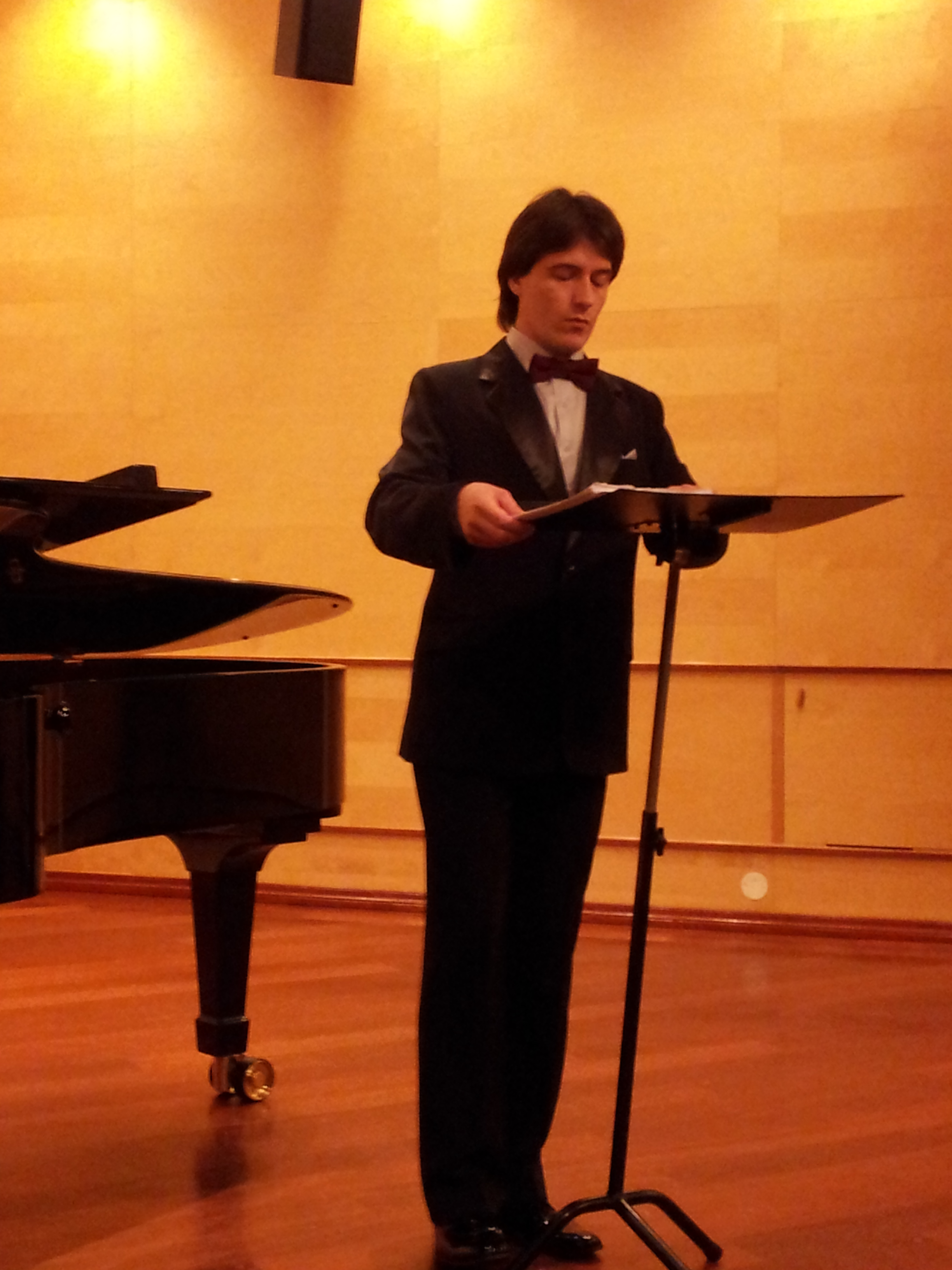
Gårsdagens recital-konsert var intet unntak: med Per Arne Frantzen ved flygelet ga han oss en time med et vakkert og variert program. Han åpnet med kardinal Brogni’s arie “Si la rigueur et la vengeance” fra Halevy’s opera “La Juive”, et perfekt eksempel på hvor vakkert en bass-arie kan fremføres!

Per Arne Frantzen og Leonid under konserten 15. januar 2014

Per Arne Frantzen og Leonid under konserten 15. januar 2014

Deretter kom Brahms’ “Vier geernste Gesänge” – også nydelig fremført, og for meg var særlig “Ich wandte mich, und sahe an” et høydepunkt. Disse sangene blir fremført så altfor sjelden, men når de får liv gjennom Larionovs fyldige bass er det klart at disse har en helt naturlig plass i hans konserter fremover!

Han avsluttet konserten på sitt morsmål, med Modest Mussorgsky’s “Songs and Dances of Death”, dramatisk fremført og med stor innlevelse, det er tydelig at Leonid trives med å synge russisk!

Neste uke er jeg innvilget audiens hjemme hos Leonid Larionov for et intervju, som vil bli publisert her. Det skal bli spennende å lære mer om mannen bak stemmen, få et innblikk i hvordan han jobber med rollene, hva som har fått han til å bosette seg i lille Norge og ikke minst noen andre spennende sider ved ham…..

Så bare kikk innom igjen i løpet av de neste ukene – og bli bedre kjent med Norges nye “up & coming” stjerne-bass!

Leonid Larionov og Maria Bordas etter en konsert i 2011

Leonid Larionov og Maria Bordas etter en konsert i 2011

Another year is gone…..

Leave a comment

….and hopefully you all had a great 2013!

I would like to thank all my readers for following me through this year as well, your messages, comments and feedbacks are much appreciated! About this time last year, I did announce some artist profiles to be written, that still hasn’t happended. Due to having had an extremely busy year, this is the result of me having a lot of other things to do – but we’ll see what I can get around to in 2014!

Although this year has been an exciting one for me (I got a new, fabulously interesting job) it has also contained some not-so-happy moments, i.e. the deaths of my very dear friends Jorun Møllerstedt and Else Skagen and also my father-in-law, who passed away just before Christmas at the age of 90.

My father-in-law, Johan on his 90th birthday, with his big sisters Helga (left, 92) and Nelly (right, 96)

My father-in-law, Johan on his 90th birthday, with his big sisters Helga (left, 92) and Nelly (right, 96)

On the homefront, my boyfriend and me celebrated our 20th anniversary together, and we plan on at least 20 more!

Jan and myself at home during Christmas 2013: Still together after 20 years!

Jan and myself at home during Christmas 2013: Still together after 20 years!

Besides music, one of my other “causes” in life is to prevent passive drinking (which means drinking that bothers other people). As a board member of the organization Familieklubbene i Norge, I was interviewed by the national newspaper VG about children who don’t look forward to celebrating Christmas because of their parents alcoholic behaviour. It is reported that this affects several hundreds of thousand children in Norway alone – I dare not think about the numbers on a world basis! My one advice is: Don’t drink when children are present!

I would like to wish each and everyone of you a very happy New Year – may 2014 be filled with joy, happiness and a lot of interesting experiences for all of you! See you next year – keep checking in for more updates!

I do toast the New Year, but with a non-alcohol champagne....

I do toast the New Year, but with a non-alcohol champagne….

Coming soon – a profile on Jackie DeShannon

Leave a comment

Jackie DeShannon – my one true musical heroine! Incredibly enough, after almost 60 years in show business, she is still “unknown territory” to a lot of people…. Still not 70 years old (she will reach that age in August 2014), she is one of very few singers still working, who actually had a 78rpm record released. Of course, she started out very young; her first record, “Baby Honey” was recorded in 1956 (and credited to Sherry Lee!), and she also used the names Jackie Dee and Jacquie Shannon before settling on the name she still goes by today.

Sherry Lee or Jackie Dee - this late 1950s publicity photo makes her look like Barbie

Sherry Lee or Jackie Dee – this late 1950s publicity photo makes her look like Barbie

Looks can indeed be deceptive; Jackie’s earliest publicity photos shows a doll like beauty and indicates a sweet, young and kinda sugary girl singer. Not so! Jackies earliest records produced some really tough sounding rockabilly, and the voice that blares out of the speakers give you absolutely no hint about her tender young age…. This teenaged girl more than holds her own when compared to Brenda Lee, and she’s maybe the only real competitor to the stuff Wanda Jackson recorded around the same time.

Later on, in the 1960’s, Jackie looked more the folk singers of the day, with her straight blonde hair, her shy smile and all around sunny appearance. While no longer singing rockabilly at that point, her record covers still give no indication to what’s actually on the records. You’d expect some ethereal, folksy stuff – and what you get is one of the most soulful white singers, doing a wide range of material. A lot of she wrote herself, and she also had a very good idea about what songs to record, outside of her own material.

Jackie in the mid-60's

Jackie in the mid-60’s

Jackie DeShannon, the songwriter is maybe more famous than Jackie the singer. A lot of songs she wrote have been recorded by dozens of artists from the early 1960’s and they are still being recorded today. The most sucessful cover of a Jackie song is of course Kim Carnes’ version of “Bette Davis Eyes” – a song Jackie herself put out on her 1975 album “New Arrangement” in 1975. Six years later, Kim topped the charts for nine consecutive weeks with her “new arrangement” and the song is now regarded as a classic pop hit.

Jackie in 2011

Jackie in 2011

Jackie has made more than 20 solo albums, and they represent some of the finest music made in the 21st Century, covering a wide array of styles – and all of it impeccably performed by one of the greatest voices in the business. Jackie had a rather long gap in her album output too; between “Quick Touches” (1978) and “You Know Me” (2000), all she released was a few singles….

In a short while, I will take a closer look into the wondrous musical legacy of Jackie DeShannon, discussing in detail a lot of her albums. She is the kind of singer who is impossible not to like, she has something that will please everybody, she has an absolutely fabulous voice and you better be warned: Jackie DeShannon is addictive! One listen and you will be craving for a lot more!

Jackie invites you to listen to her - you will not regret it

Jackie invites you to listen to her – you will not regret it

Sylvie Vartan – Europe’s brightest shining Star for 50 years

Leave a comment

Sylvie is amazing – period! For 50 years, she has been star, not only in France but also around the world. She easily adapts to any current musical trend, she has made an incredible amount of records, her legs is in the legendary league with Marlene Dietrich, Betty Grable and Angie Dickinson, she has the face of an Ivory goddess – above all she is blessed with talent – the kind that comes only once in a lifetime! To sum up everything Sylvie Vartan has done through her long and magnificent career is impossible, but I will take you through a closer look at some of her albums and hopefully prove that Sylvie is one of the most important artists to come out of Europe in the last century!

Sylvie in the early 1960's; beauty and talent was never more exquisitely combined...

Sylvie in the early 1960’s; beauty and talent was never more exquisitely combined…

Although she is always considered a French singer, Sylvie Vartanian was born on August 15 1944 in Iskretz, Bulgaria to a Hungarian mother and an Armenian/French father. For the first eight years of her life, Sylvie lived in Sofia, Bulgaria – moving with her family to Paris, France in 1952. The family lived in a single hotel room for four years while carving out a living for themselves, even the young Sylvie had to work hard, all the while learning French…. So her first years in her new homeland was not very glamorous, and certainly light years away from her later life.

In 1960, her brother Eddie worked as a record producer and Sylvie was also very interested in music. Jazz was her first love, but just to rebel against her strict high school, rock ‘n’ roll was also something Sylvie listened to, Brenda Lee being a favorite! In 1961, Eddie was looking for a young girl to duet with French rocker Frankie Jordan, on the track “Panne D’essence” – he chose his sister. The song was a hit, and Sylvie got to appear on television for the first time. Later in 1961, she signed a contract with RCA records – and she stayed with that company for 25 years, achieving status as the labels biggest selling female singer and second best selling singer overall, beat only by Elvis Presley. Her first big solo hit was “Quand le film est triste” – and from that point on, she started on her never-ending rise to superstardom, and a musical career that is unequalled to anyone else!

Sylvie was initially billed as the “twisting schoolgirl”, and in the early 60’s she often recorded French versions of current pop and rock hits, then later in the 60’s she recorded a lot more original songs, and turning into a more adult performer. If you played all of her records back to back, you’d hear a singer in constant development. The very young Sylvie who sang “Le Locomotion” is miles away from i.e. the late 1960’s “La Maritza”. She easily took on both new and older material, and performed a typical current hit like “Le jour qui vent” as naturally as she did songs associated with Edith Piaf (“Hymne a l’amour”) or Jacques Brel (“Ne me quitte pas”),  with the same intensity and soulful approach. With each new Sylvie album, you’d never know what to expect; she chose great cover songs and a lot of exciting new material. In the early 70’s she was one of the first French artists to do country songs, putting her own personal stamp on hits by Tanya Tucker, Lynn Anderson and Olivia Newton-John. Always exciting, and eternally surprising – within one year she sang (in English) an early “almost-disco” version of “Love is blue” and a semi-classical piece based on a Mozart Symphony, “Caro Mozart” (sung in Italian)! The almost schizophrenic approach to releasing albums had started even in the early 60’s: her 1964 album “Sylvie A Nashville” found her singing in French (and it’s not really a country album), while 1965s “Gift Wrapped From Paris” found her singing entirely in English, one track being the Angels recent no. 1 hit “My boyfriend’s back”…..

1965 album "Gift Wrapped from Paris"

1965 album “Gift Wrapped from Paris”

Besides doing a wide range of different material, and singing in different languages – there is also the aspect of the Vartan voice, which is very flexible, and can be shaped and moulded to fit any kind of musical arrangements. She can sound sweet and intimate one moment, then she roughs up her vocals the next – and makes it sound a little more ragged for singing rock. But she still sounds like Sylvie all the time!
"Made in USA" (1985) shows off her talent for doing  rock and dance material

“Made in USA” (1985) shows off her talent for doing rock and dance material

Some examples of her different ways of singing: “La plus belle pour aller danser” (1964) (sweet & girlish), “I’m watching you” (1963) (rough & a little strained even), “La Maritza” (1968) (a heartfelt, folkish kind of song), “I don’t want the night to end” (1979) (an almost seven minute disco track), “I saw Mary” (1985) (a synth & guitar heavy rock song), “Dernier acte” (1992) (another rock track, very current – sung in French), “Ruby Tuesday” (2007) (a great version of the old Stones song). She released more than 40 albums for RCA during the 25 years she was signed to that label, and another 15 or so during the last 25 years, the latest being the great 2011 album “Soleil Bleu”. So there is quite a lot of records to listen to, and I would highly recommend any and all of them!

From the "soleil Bleu" cover photo sessions; Sylvie at age 66 has both looks and talent still in Place!

From the “Soleil Bleu” cover photo sessions; Sylvie at age 66 has both looks and talent still in place!

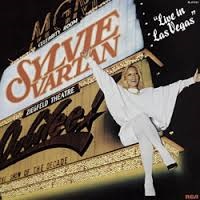
Musically, there is a Sylvie Vartan record for everybodys taste. She is the ultimate entertainer, and there are also several live albums available, proving why her concerts and shows are always sell-outs. Maybe the best of these is “Live In Las Vegas” (1982) – she is literally in her element here, and in addition to singing some of her greatest hits, she also does great versions of hit songs done by other artists: “Gloria” (Laura Brannigan), “Bette Davis Eyes” (Jackie DeShannon/Kim Carnes) and “No More Tears (Enough is enough)” (Barbra Streisand/Donna Summer). She melds some of her early 60s hits into a “Ye Ye medley” and tops it all off with a raucous version of “Shake a tail feather”. This is for once, a live album where you actually feel that you are sitting in the first row, having Sylvie singing for only you…

With an introduction by Gene Kelly, Sylvie gives Las Vegas the show of her life!

With an introduction by Gene Kelly, Sylvie gives Las Vegas the show of her life!

Like a lot of other legendary singers, all of Sylvie’s catalogue is still on the market, so any original album you want is possible to get. There are dozens of collections of course – some of her material has been repackaged several times for a lot of different “best of” CDs that vary in quality and content… However, RCA has done a marvellous job with their Sylvie collections:  the first time around, they put together all of her best songs into the box set “Les Annees RCA – L’intgrale Studio 1961-86”, a 21 CD set of the best tracks from all her studio albums recorded for RCA.

This 21 CD Box Set collects her best RCA studio recordings

This 21 CD Box Set collects her best RCA studio recordings

How do you top this box? Well, RCA did it themselves when they released their next big Sylvie box a few years ago: gathering up absolutely every one of her RCA albums, both live and studio produced the totally stunning 41 CD Box set pictured below. It does cost money, but not only do you get a total view of the first 25 years of the career of Europe’s most important female singer – it is also a great portrait of the evolution of pop music in Europe. And all of it performed by a great artist, putting her personal stamp on several hundred great songs!

This 41 CD Box Set collects her entire recorded output 1961-86!

This 41 CD Box Set collects her entire recorded output 1961-86!

The albums are packaged as mini LPs, with their original cover art. It also includes a thorough little book, summing up her career and listing all the contents of all the original albums, as well as the many bonus tracks added to most of them.

A beautiful photo from the early 1980's

A beautiful photo from the early 1980’s

I could go on and on about Sylvie, but I will end this post by once again stating the importance of what she has done musically through the last 50 years. Her fabulous voice, her excellent choice of songs (both originals and covers), her way of putting it all across to the listeners. She is talent personified, she is unique in the history of popular music and she most definitely is the brightest shining star in the European musical universe – yesterday, today and forever!

2010

La Grande Vartan, pictured ca. 2010


Else Skagen – Minneord

Leave a comment

Hun var en av de  norske artistene på 60-tallet som ga seg altfor tidlig…. Noen husker henne med glede, andre vet ikke hvem hun var. Else vokste opp i Bodø, men bodde i Oslo i mange år fra slutten av 1970-tallet…

En av Else's singler; denne er fra 1968 og sørget for at hun også opptrådte i "Popkorn" på norsk TV

En av Else’s singler; denne er fra 1968 og sørget for at hun også opptrådte i “Popkorn” på norsk TV


Magasinet Bodø NU ba meg om å skrive en minneartikkel om Else – noe jeg med største glede gjorde! I dag har magasinet publisert den, du kan lese oppslaget i sin helhet ved å klikke på lenken under:

http://bodonu.no/ett-av-60-tallets-stjerneskudd-har-sluknet-for-godt/

Som det fremgår av artikkelen, så tilhører Else Skagen de som hadde mer enn nok talent til å kunne ha blitt en av de store, men hun valgte å gjøre andre ting i livet.


Oppdatering, april 2014:

50 år etter at den be spilt inn, gikk et eksemplar av Else Skagens debut-singel ut med utropspris på 175,- på en nettauksjon. Resultatet ble at den ble solgt for kr. 1700,-!! Else hadde garantert sagt noe a la “Æ flire mæ i hjæl” dersom hun hadde levd og fått med seg dette salget!

Bildet av 1964-singelen “Hvite Perler”/”Du Skulle Skamme Deg” ser du under her….

Den 15-årige talentkonkurranse-vinneren fikk så klart spille inn plate!

Den 15-årige talentkonkurranse-vinneren fikk så klart spille inn plate!


En lenke som omhandler auksjonssalget, kan du lese her: http://tidogrom.blogspot.no/2014/02/bod-pop-fra-1964-else-skagen.html


Else Skagen, fotografert i sitt hjem i Josefinesgt. i Oslo, 1993

Else Skagen, fotografert i sitt hjem i Josefinesgt. i Oslo, 1993

For meg var hun først og fremst en av mine beste venner – og det er derfor hyggelig å kunne bidra til å hedre hennes ettermæle på denne måten.


Older Entries Newer Entries